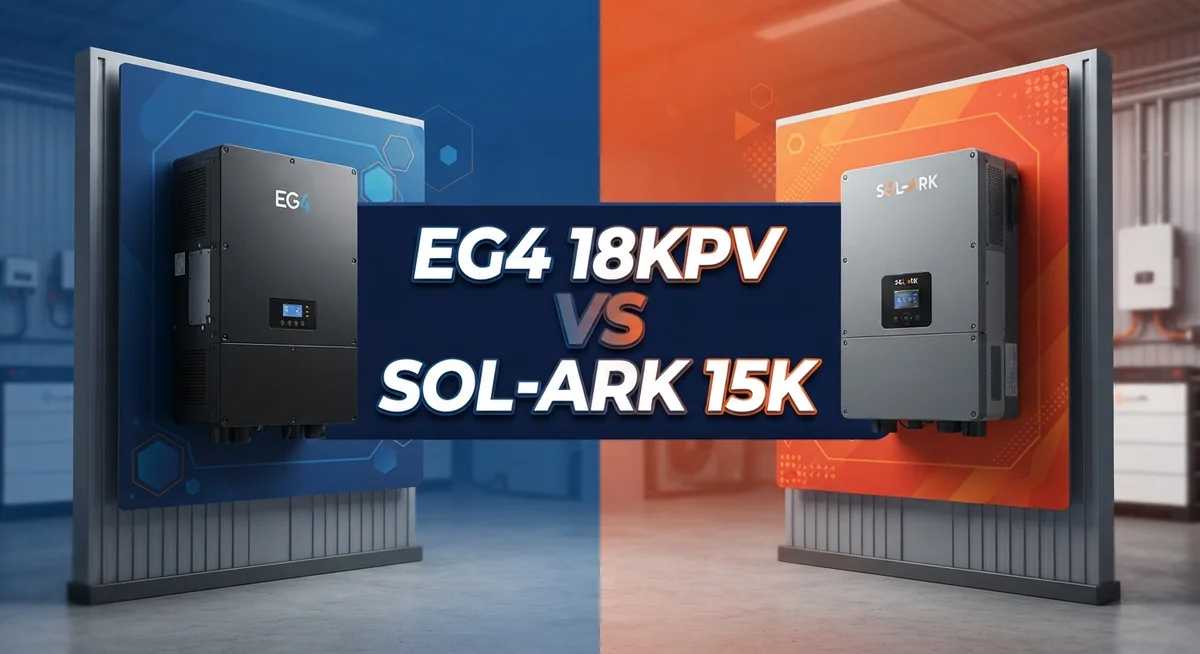
EG4 18KPV vs Sol-Ark 15K: Complete Inverter Comparison Guide
Choosing a solar inverter feels like a big decision. You want power that matches your home.
You also want a setup that fits your skills and goals.
The EG4 18KPV and Sol-Ark 15K are two popular choices among solar users. Both handle split phase power.
Both work well for grid tie and off grid systems.
But they serve different needs. The EG4 18KPV focuses on simple installation and flexible battery compatibility.
The Sol-Ark 15K offers higher continuous output and more advanced solar input options.
This guide breaks down specs, strengths, and weaknesses for each inverter. We compare power output, wiring complexity, and scalability.
By the end, you will know which inverter fits your home and your solar goals.
Quick Comparison: EG4 18KPV vs SOL-ARK 15K
| Feature | EG4 18KPV | SOL-ARK 15K |
|---|---|---|
| Continuous AC Output | 12kW | 15kW |
| PV Input | 18kW (21kW max) | Not specified |
| Battery Voltage | 48VDC | 48VDC |
| AC Output Type | 120/240V split-phase | 120/240V split-phase |
| MPPT/Solar Ports | Not specified | 3 MPPTs, 6 DC ports |
| Grid Bypass | Not specified | 200A grid bypass |
| Weight | 121.25 lbs | Heavier system |
| Installation Complexity | Easier wiring | More complex setup |
EG4 18KPV Review

- Advanced Safety & Long-Lasting Reliability: Engineered for total peace of mind, this 48V...
- Real-Time Monitoring via Display & App: Stay in control with multiple monitoring options...
Last update on 2026-10-22 / Affiliate links / Images from Amazon Product Advertising API
The EG4 18KPV-12LV is a hybrid solar inverter designed for homeowners who want straightforward installation without sacrificing performance. It delivers 12kW continuous AC output with an 18kW PV input capacity, making it ideal for moderate energy needs.
This inverter stands out for its simple wiring configuration and compatibility with multiple battery brands. You get seamless switching between grid-tie and off-grid modes, plus remote Wi-Fi monitoring so you can check your system from anywhere.
The 48VDC battery system and 120/240V split-phase output give you flexibility in how you set up your home. Real-world users appreciate how quickly they can get the system running without complex electrical work.
Build quality is solid, and the unit weighs 121.25 lbs, making it manageable for most installations. The straightforward design means fewer points of failure and easier troubleshooting down the road.
Pros
- Easier wiring and setup compared to multi-MPPT inverters
- Works with batteries from different manufacturers
- Remote Wi-Fi setup and monitoring included
- Smooth grid-tie to off-grid transitions
Cons
- 12kW continuous output may limit running multiple high-power appliances simultaneously
- Limited technical documentation available online
SOL-ARK 15K Review

- ⚡ 15,000W Hybrid Inverter – The Sol-Ark 15K-2P delivers 15kW of continuous power with...
- 🔋 Expandable Battery Compatibility – Supports 48V LiFePO4, lithium, and lead-acid...
Last update on 2026-10-22 / Affiliate links / Images from Amazon Product Advertising API
The Sol-Ark 15K-2P is a hybrid solar inverter built for homeowners with larger energy needs and complex solar setups. It delivers 15kW continuous AC output, making it ideal for homes running multiple high-power appliances at once.
This inverter features six DC solar ports and three full-sized MPPTs, letting you connect multiple solar arrays independently. The 200A grid bypass enables efficient on-grid operation, while 19kW AC coupling capability opens doors for future system expansion.
Build quality is robust, though the system weighs more than single-MPPT competitors. Real-world performance shows reliable switching between grid-tie and off-grid modes, with consistent power delivery even under heavy loads.
The 120/240V split-phase output works well for modern homes needing balanced power distribution across circuits. This inverter scales beautifully if you plan to add more solar panels or batteries later.
Pros
- Higher continuous output (15kW) handles simultaneous heavy loads without strain
- Multiple MPPT inputs support complex multi-array solar configurations
- 200A grid bypass improves on-grid efficiency and performance
- Excellent scalability for future system upgrades and expansions
Cons
- More complex wiring and setup requires technical knowledge or professional help
- Heavier system makes installation more labor-intensive
- Steeper learning curve compared to simpler single-MPPT inverters
Head to Head: Key Differences
The EG4 18KPV delivers 12kW continuous AC output, while the Sol-Ark 15K pushes 15kW. That 25% difference matters when you run multiple heavy appliances at once.
Solar input flexibility separates these two inverters. The EG4 accepts up to 21kW of PV input through a single MPPT controller.
The Sol-Ark features three full-sized MPPTs across six DC solar ports, letting you connect multiple solar arrays without power loss from shading or mismatched panels.
Installation complexity tells a different story. The EG4 uses straightforward wiring that most DIY installers handle easily with its split-phase 120/240V output.
The Sol-Ark requires more planning due to its advanced architecture, though experienced installers appreciate the extra control and scalability.
Battery compatibility works differently too. The EG4 connects to multiple battery brands thanks to its open 48VDC design.
The Sol-Ark also supports various batteries but demands more precise configuration during setup.
Grid operation shows another distinction. The Sol-Ark includes a 200A grid bypass, making on-grid transitions smoother and more efficient.
The EG4 handles grid tie and off-grid switching seamlessly but without dedicated bypass hardware.
Future expansion capacity favors the Sol-Ark. Its three MPPT inputs and higher continuous output accommodate system growth better.
The EG4 works well for current needs but offers less room to add solar or increase loads later.
Weight and physical space matter for installation. The EG4 is lighter at 121.25 lbs, simplifying wall mounting and transport.
The Sol-Ark weighs more, requiring stronger mounting infrastructure.
Choose the EG4 for straightforward setups with moderate power needs and single solar arrays. Pick the Sol-Ark for larger homes, complex solar configurations, or plans to expand your system.
Which One Should You Buy
The Sol-Ark 15K takes the win in this matchup. It delivers higher continuous AC output and stronger MPPT configurations than the EG4 18kPV.
This makes it the better choice for demanding solar setups. Homes with growing energy needs will benefit most from its scalability.
The EG4 18kPV still holds its own though. It shines in simpler setups where ease of use matters most.
Best for each buyer
- EG4 18kPV: Great for DIY installers and homeowners with moderate power needs who want simple wiring and easy installation.
- Sol-Ark 15K: Ideal for larger homes or properties that need high simultaneous loads, complex multi-array solar setups, and room to grow in the future.
Frequently Asked Questions
Which inverter handles more simultaneous loads?
The Sol-Ark 15K-2P delivers 15kW of continuous AC output. The EG4 18KPV-12LV provides 12kW.
This 3kW difference matters when you run multiple heavy appliances at once. If your home needs to power an air conditioner, electric water heater, and kitchen equipment simultaneously, the Sol-Ark handles it without strain.
The EG4 works fine for moderate loads but may throttle if you push too many devices at once.
Can I expand my system later with either inverter?
Yes, but the Sol-Ark offers more room to grow. It features three full-sized MPPTs and six DC solar ports.
You can add more solar arrays without replacing the inverter. The EG4 has one MPPT, so future solar expansion becomes limited.
If you plan to add panels in 3 to 5 years, the Sol-Ark gives you flexibility. The EG4 works better if you’re satisfied with your current system size.
Which one is easier to install myself?
The EG4 18KPV wins here. It has simpler wiring configuration and remote Wi-Fi setup.
DIY installers appreciate the straightforward design. The Sol-Ark demands more planning and careful configuration during installation.
Experienced electricians handle Sol-Ark setups smoothly, but beginners may find it challenging.
What if I have a complex multi-array solar setup?
Choose the Sol-Ark 15K-2P. Its three separate MPPTs let you connect multiple solar arrays independently.
Each MPPT tracks power separately, maximizing output from different roof angles or orientations. The EG4’s single MPPT works best for simple, single-array systems.
Which inverter works better for grid-tied homes?
The Sol-Ark 15K-2P includes a 200A grid bypass. This feature improves on-grid efficiency significantly.
The EG4 also switches between grid and off-grid modes smoothly but lacks the advanced grid integration. For homes that stay connected to the utility grid most of the time, the Sol-Ark performs better.